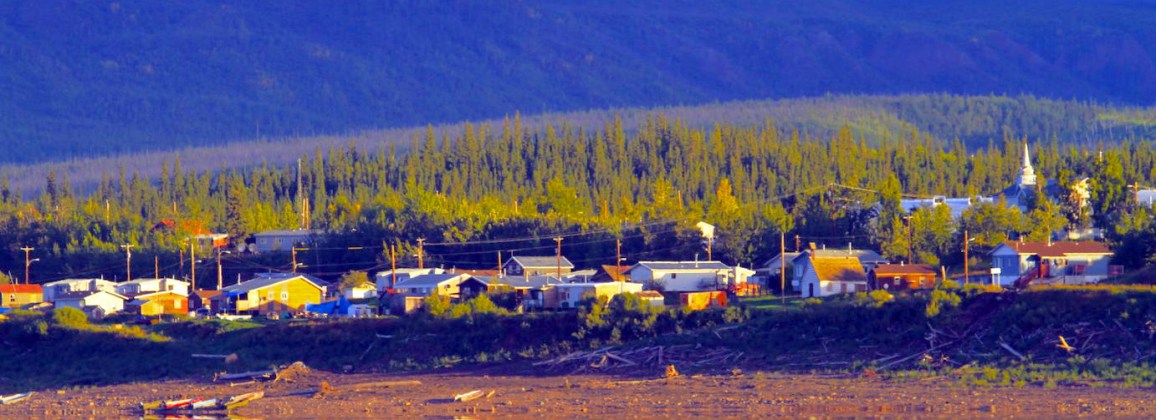
The Sahtu region of the Diocese of Mackenzie–Fort Smith occupies a vast and spiritually resonant heartland of the Northwest Territories, where Catholic pastoral life unfolds within an Indigenous world deeply shaped by land, memory, and community. Centered along the middle reaches of the Mackenzie River and encircling Great Bear Lake, the Sahtu is both geographically immense and sparsely populated, requiring a form of ministry marked more by presence and relationship than by programs or institutions.
The region includes the communities of Délı̨nę, Fort Good Hope, Tulita, Norman Wells, and Colville Lake, each with its own history, rhythms, and pastoral needs. Norman Wells serves as the regional service hub, while the other communities are smaller and predominantly Sahtu Dene and Métis. Travel between them depends on aircraft year-round and winter roads or river transport seasonally, making pastoral ministry logistically complex and highly dependent on weather and timing. Priests and pastoral workers often serve multiple communities, spending extended periods away from one parish in order to be present in another.
The people of the Sahtu trace their identity to Great Bear Lake (Sahtú), a place of profound cultural, spiritual, and ecological significance. Traditional practices such as hunting, fishing, trapping, and living on the land remain central to community life and to the transmission of values between generations. Spirituality in the Sahtu is not confined to formal worship but is woven into relationships with the land, respect for Elders, storytelling, and the shared responsibility of caring for one another. Catholic ministry in this context must therefore engage not only with church buildings but with the broader spiritual landscape in which people live.
The Catholic presence in the Sahtu dates back to the 19th century, when Oblate missionaries traveled the Mackenzie River by canoe and dog team, establishing missions that became focal points of community life. This history includes sincere faith and commitment, but also painful associations with colonial structures and residential schools. As a result, contemporary pastoral ministry in the Sahtu emphasizes listening, humility, healing, and reconciliation, recognizing the Church’s responsibility to walk with communities rather than speak for them.
Parish life in the Sahtu is shaped by small congregations and strong local leadership. Lay ministers and community members play a vital role in sustaining faith life when priests are absent, leading Sunday Celebrations of the Word, prayer services, funerals, and seasonal devotions. Liturgies are often simple and deeply communal, sometimes incorporating Indigenous languages and symbols that reflect local culture and experience. Elders are especially important carriers of wisdom and faith, bridging Catholic practice with Indigenous identity.
The region also faces significant challenges that shape pastoral priorities. Isolation, high living costs, housing shortages, intergenerational trauma, addiction, and the growing impacts of climate change—such as changes to ice, wildlife patterns, and river travel—affect daily life. At the same time, Sahtu communities are marked by resilience, generosity, humour, and a strong sense of mutual care. These qualities offer a living testimony to hope and endurance, even amid hardship.
Within the Diocese of Mackenzie–Fort Smith, the Sahtu region calls the Church to a distinctive way of being present: slow, relational, and attentive to place. Ministry here is not defined by numbers or visibility but by trust built over time and by accompaniment through life’s ordinary and sacred moments. In the Sahtu, the Church learns again that the Gospel takes root most deeply when it is lived alongside the people, grounded in the land, and expressed through shared life in one of Canada’s most enduring northern homelands.
 Mackenzie-Fort Smith