Our Lady of Victory Parish (Igloo Church)
- Regional Pastor: Fr. Fredrick Omegoha (ofredrick244@gmail.com)
- Pastoral Leader: Miki O’Kane (arctictern@northwestel.net)
Box 2033 Inuvik, NT X0E 0T0
Parish phone: (867) 777-2236
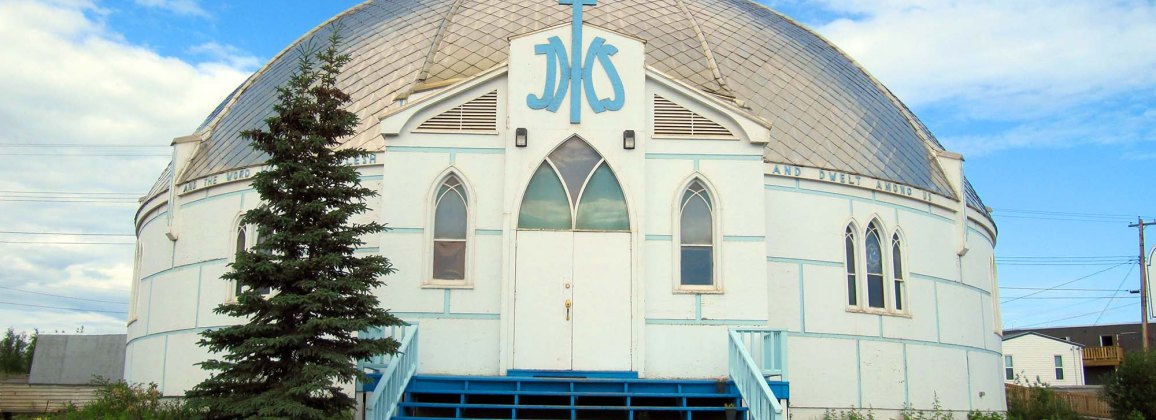
Our Lady of Victory Church in Inuvik, widely known as the Igloo Church, stands as one of the most recognizable symbols of Catholic life and northern ingenuity in Canada’s Western Arctic. Situated above the Arctic Circle in the heart of Inuvik, the church is both a functioning parish and a cultural landmark, reflecting the Church’s long presence in the Mackenzie Delta and its effort to root Christian worship within the realities of northern land, climate, and culture.
The church was constructed between 1958 and 1960, during the early years of Inuvik’s development as a planned northern community. It was designed by Brother Maurice Larocque, an Oblate missionary and skilled carpenter rather than a formally trained architect. Faced with the unique challenges of permafrost, extreme cold, and limited building resources, Brother Larocque conceived a circular, dome-shaped structure inspired by the traditional igloo. The design was not merely symbolic; its rounded form helped distribute weight evenly and reduce damage caused by frost heave, making it well suited to Arctic conditions. Building materials, including much of the lumber, were transported long distances down the Mackenzie River, underscoring the logistical challenges of northern construction.
Architecturally, the Igloo Church is notable for its innovative foundation and structure. Instead of being raised on piles like many Arctic buildings, it rests on a bowl-shaped concrete slab over gravel, designed to move gently with the frozen ground beneath it. Inside, a series of wooden arches supports the dome, creating an open, welcoming worship space that can seat several hundred people. The interior is both simple and warm, shaped by the needs of a close-knit northern parish rather than by grandeur or ornamentation.
Spiritually and pastorally, Our Lady of Victory has long served a diverse Arctic community that includes Inuvialuit, Gwich’in, and people from across Canada and beyond who have made Inuvik their home. The parish reflects this diversity in its liturgical life, where prayer, music, and preaching often acknowledge multiple languages and cultures. Indigenous artwork within the church, including murals and symbolic imagery, expresses a growing commitment to honoring Indigenous voices and experiences within the life of the Church.
Beyond its role as a parish, the Igloo Church has become a symbol of Inuvik itself. It is one of the most photographed buildings in the North and a regular stop for visitors traveling the Dempster Highway or exploring the Mackenzie Delta. Yet for local residents, its significance runs deeper than tourism. It has been a place of baptism, marriage, funerals, and community gathering for generations, accompanying people through moments of joy, grief, and transition in a region marked by isolation and resilience.
Today, like many northern structures, Our Lady of Victory faces challenges from climate change, particularly the thawing of permafrost beneath its foundation. Ongoing efforts to monitor and preserve the building reflect not only concern for a historic structure but also the enduring importance of the church as a spiritual home for the people of Inuvik.
In its distinctive form and enduring presence, Our Lady of Victory Church embodies the meeting of faith and Arctic life. The Igloo Church stands as a quiet but powerful witness to a Church that has learned—sometimes imperfectly—to adapt, to endure, and to seek belonging in the far North, shaped by the land and the people it serves.
 Mackenzie-Fort Smith