Our Lady of the Arctic
- Regional Pastor-Fr. Gerald (Mick) Fleming (mickcssr@gmail.com)
- Pastoral Leader: Vicki Aitaok (vicki.aitaok@icloud.com)
Box 82 Cambridge Bay, NU X0B 0C0
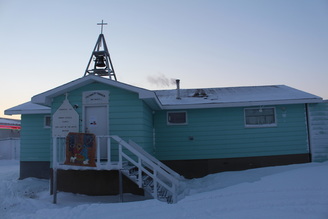
In the remote and windswept reaches of the Canadian Arctic lies Cambridge Bay (Iqaluktuuttiaq in Inuinnaqtun), a hamlet on Victoria Island that is both a centre of Inuit culture and one of the northernmost communities served by the Roman Catholic Diocese of Mackenzie-Fort Smith. In this starkly beautiful environment—where long summer days and polar nights shape the rhythms of life—Our Lady of the Arctic stands as the local Catholic parish, a place of worship, community, and continuity for Catholics living in the Kitikmeot region of Nunavut.
Founded as part of the diocese’s mission outreach into the Arctic, Our Lady of the Arctic embodies both the historical legacy and contemporary presence of Catholicism in Canada’s Far North. The Catholic Church’s involvement in the Arctic stretches back to 19th-century missionary efforts, when priests and religious crossed vast distances over tundra, rivers, and sea ice to establish missions among Indigenous peoples. These early efforts helped lay the foundations for the network of parishes and missions that serve isolated communities today.
The current church in Cambridge Bay bears the evocative name Our Lady of the Arctic, a title that reflects the unique setting of its ministry. As a mission of the diocese, it operates under the spiritual leadership of the priest assigned to the Co-Cathedral of St. Patrick in Yellowknife, while local lay leadership supports day-to-day pastoral care. This arrangement is typical of northern parishes, where vast distances and small populations make full-time clergy rare and local involvement essential to sustaining parish life.
Historically, Cambridge Bay’s Catholic presence predates the current church. In 1954, Oblate missionaries built a stone church in the community using locally sourced materials, binding its walls with a mixture of seal oil and clay—a striking example of adaptation to northern conditions and an early focal point of Catholic worship in the region. Unfortunately, this heritage structure was destroyed by arson in 2006, leaving only charred remnants of its walls and a powerful reminder of both vulnerability and resilience in northern history.
After the loss of the stone church, the community continued worship in the later-built Our Lady of the Arctic, which dates from the 1970s and represents the third Catholic church to serve Cambridge Bay since the 1950s. Even as buildings changed, parishioners maintained their commitment to communal worship, sacraments, and the traditions of Catholic life in the Arctic.
More than a physical structure, Our Lady of the Arctic functions as a spiritual home for Catholics in a region where isolation and harsh climate make community ties all the more important. Liturgical celebrations such as Sunday Mass, feast day observances, and sacraments connect residents not only with their faith but also with a broader community that spans the North. In areas like Cambridge Bay, churches frequently serve dual roles: they are both places of worship and spaces for social gathering, mutual support, and cultural resilience against the backdrop of Arctic life.
In this way, Our Lady of the Arctic reflects both the continuity of Catholic mission in Canada’s North and the dynamic life of a parish set within Inuit Nunangat—blending spiritual heritage with local identity. It exemplifies how religious life adapts to context, nurtures community, and persists even amid geographic extremes and historical challenges.
 Mackenzie-Fort Smith