Our Lady of Providence
- Pastor: Fr. Lawrence Amamchukwu (amamlaw2k2@gmail.com)
- Pastoral Leader: Rosemary Squirrel (smarychnero@yahoo.com)
- Pastoral Leader: Monique Sabourin (moniquesaourin15@gmail.com)
Box 19 Fort Providence, X0E 0L0
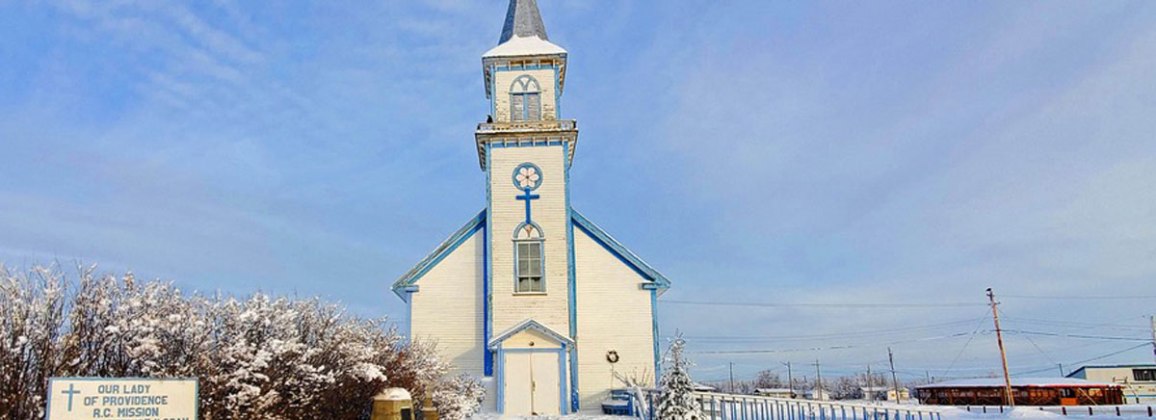
The Church of Our Lady of Providence stands in the small Dehcho community of Fort Providence, Northwest Territories, a settlement with deep historical ties to Indigenous cultures, early European missions, and the Catholic presence in the Canadian North. Fort Providence, known in the Dene language as Zhahti Kųę, meaning “the mission house,” developed around a Roman Catholic mission first established in the 1860s. This early foundation made Fort Providence one of the oldest centres of Catholic missionary activity in the Northwest Territories, and the church remains a visible reminder of that history.
The present church building was constructed in 1899 by the Oblates of Mary Immaculate. Set near the Mackenzie River, it became both a spiritual and geographic landmark in the community. Its modest design reflects the practical realities of northern life: a simple wooden structure, traditionally painted white with light blue trim, offering shelter, warmth, and a sense of stability in an often harsh environment. Like many mission churches of the era, it was built not for grandeur but for gathering a small, faithful community around prayer and sacrament.
Inside, the church is characterized by a plain but dignified interior. Wood paneling, simple lines, and an uncluttered sanctuary create a space focused on worship rather than ornamentation. Devotional art, including a prominent image of Our Lady of Providence above the altar and locally crafted Stations of the Cross, ties the universal Catholic tradition to the lived experience and creativity of the local community. These elements speak to a faith that has been sustained not only by clergy but also by generations of local parishioners.
Because of the long and severe winters typical of the region, the church historically functioned mainly as a summer worship space. During the coldest months, when heating a large building was difficult, liturgies and prayers often took place in homes or smaller, more easily heated spaces. This practice highlights the adaptability of the community and the way faith life in the North has always been shaped by climate, geography, and seasonal rhythms.
The Church of Our Lady of Providence is also inseparable from the broader and more complex history of Fort Providence as a mission centre. Nearby stood the Sacred Heart Residential School, an institution that profoundly affected Indigenous families in the region. Many children died there, often from illness, and their memory remains present in the community today. Memorials and the local cemetery bear witness to this painful history, making the church grounds a place not only of worship but also of remembrance and reflection. In this context, the church stands at the intersection of faith, suffering, and ongoing efforts toward truth and reconciliation.
Today, the Church of Our Lady of Providence continues to serve as a symbol of enduring faith in a small northern community. It reflects both the strengths and the wounds of its history, offering a space where prayer, memory, and community life come together. Rooted in the land and shaped by generations of Dene and settler Catholics, the church remains an important spiritual landmark in Fort Providence, carrying forward a story that is deeply woven into the life of the Northwest Territories.
 Mackenzie-Fort Smith