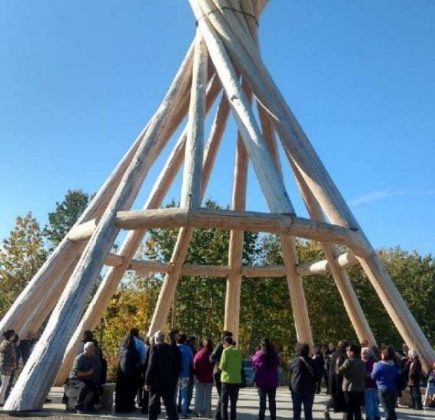
The Dehcho region—often spelled Deh Cho in Dene language which means “Big River” referring to the Mackenzie River—is the southwestern administrative and cultural heart of the Mackenzie-Fort Smith Diocese in Canada’s Northwest Territories. Situated at the confluence of geography, tradition, and faith, the region reflects a deep interplay between Indigenous land and culture and the long-standing presence of the Catholic Church in northern Canada.
The Dehcho region stretches across the southwestern corner of the Northwest Territories, bounded by the Yukon to the west, the Sahtu and North Slave regions to the north and east, and British Columbia and Alberta to the south. Its landscapes are spectacular and diverse: from the boreal forests and wetlands of the taiga plain to the rugged Mackenzie Mountains and the clear waterways of the Liard and Mackenzie Rivers. Within this tapestry lie iconic natural features such as Nahanni National Park Reserve with Virginia Falls—a UNESCO World Heritage Site—and the spectacular peaks known as the Cirque of the Unclimbables.
At the centre of the region is Fort Simpson (Łı́ı́dlı̨ı̨ Kų́ę́ in Dene), located at the meeting point of the Mackenzie and Liard Rivers. For millennia, this confluence has been a central gathering place for the Dene people, whose ancestors inhabited the land for thousands of years and continue to maintain traditions of hunting, fishing, and seasonal mobility. Archaeological and oral histories describe continuous habitation and the seasonal rhythms that structured life here long before European contact.
The region’s communities—Fort Simpson, Fort Liard, Jean Marie River, Nahanni Butte, Sambaa K’e (Trout Lake), and Wrigley—are small and predominantly Indigenous, with populations that range from just a few dozen to over a thousand people in Fort Simpson, the administrative and transportation hub. IT Infrastructure These communities reflect Dene and Métis identities, languages, and cultural practices, including traditional arts such as birchbark basketry and moosehide work, seasonal harvesting of fish and game, and music and gatherings that celebrate communal life.
Embedded in the region’s vast wilderness is the Edéhzhíe Protected Area, an Indigenous Protected and Conserved Area co-managed with the Government of Canada. Covering over 14,000 km² of lakes, forests, and wetlands, Edéhzhíe plays a vital ecological and cultural role, supplying fresh water and critical habitat for migratory birds and wildlife—and reflecting the deep connection between land and people that defines the Dehcho.
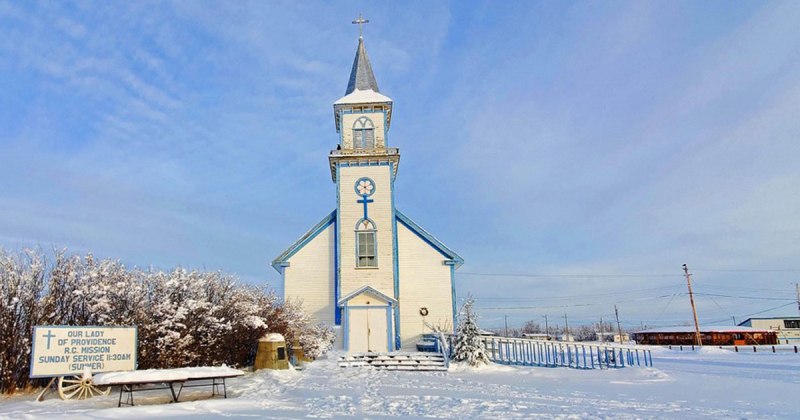
In Fort Simpson itself, Sacred Heart Church has been a focal point of Catholic life, emblematic both of faith and community identity. A new church building—supported through diocesan and local efforts—replaced an aging structure and continues to serve as a gathering place for worship and celebration. Mackenzie-Fort Smith However, this presence also exists within the broader context of reconciliation and historical critique. The Dehcho First Nations have publicly called on the Catholic Church and wider society to repudiate colonial doctrines such as the Doctrine of Discovery, reflecting ongoing efforts to address the impacts of colonialism, residential schools, and imposed legal frameworks on Indigenous land and culture.
Thus, the Dehcho region of the Mackenzie-Fort Smith Diocese is more than an administrative area—it is a land where rivers and stories converge, where tradition and faith meet, and where Indigenous identity continues to grow alongside evolving relationships with religion, governance, and natural world stewardship. Its communities encapsulate both resilience and vibrancy, rooted in deep ancestral ties to land even as they navigate the challenges and opportunities of the present.
 Mackenzie-Fort Smith