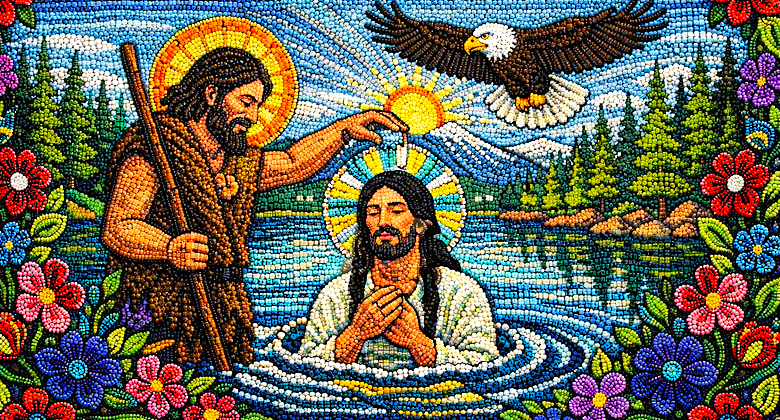

At the Jordan River, Jesus steps quietly into the water, joining a long line of people who carry with them hunger for healing, forgiveness, and hope. He does not arrive above them or apart from them, but among them. In that simple, humble gesture, God reveals something essential about how divine love moves in the world: it begins by drawing near.
Ours is a Church that knows wide distances, small communities, fragile connections, and the slow work of trust. Like the Jordan, our places of ministry are not grand or dramatic, but they are real—riverbanks, gravel roads, community halls, modest churches, kitchens, and hospital rooms. It is precisely there that Christ chooses to stand with his people.
As Jesus enters the water, the words of Isaiah seem to unfold before our eyes: Here is my servant, whom I uphold. This servant does not force justice or raise his voice over others. He does not break what is already bruised. In a northern Church shaped by endurance, patience, and resilience, this image speaks clearly. Ministry here is often quiet and unseen. It is showing up when travel is difficult, listening when wounds run deep, and remaining present even when resources are few. This is the gentle strength of the Servant whom God delights in.
From that baptismal moment, Jesus moves outward, anointed by the Spirit, bringing healing and hope wherever life is wounded. Peter later reflects that God shows no partiality, and that Jesus went about doing good. This is a powerful affirmation for a Church that serves across cultures, languages, and traditions. Whether through sacramental life, pastoral care, education, reconciliation, or simple presence, our calling mirrors Christ’s own: to let the Spirit lead us into places where healing is needed most.
The Baptism of the Lord is not only a moment we remember; it is a pattern we live. In baptism, we too were claimed and sent—into remote communities, into complex histories, into relationships that require humility and patience. Like Jesus, we are called not to dominate, but to accompany; not to stand above, but to stand with.
As we celebrate this feast, may we recognize Christ still wading into the waters of our own reality—into its beauty and its brokenness. May we trust that the same Spirit rests upon this diocese, guiding its people with quiet strength. And may we continue our ministry grounded in the deep assurance that, even here, even now, God’s voice still speaks over the waters, calling us beloved and sending us forth in peace.
 Mackenzie-Fort Smith